One console for every tank, gate and rupee
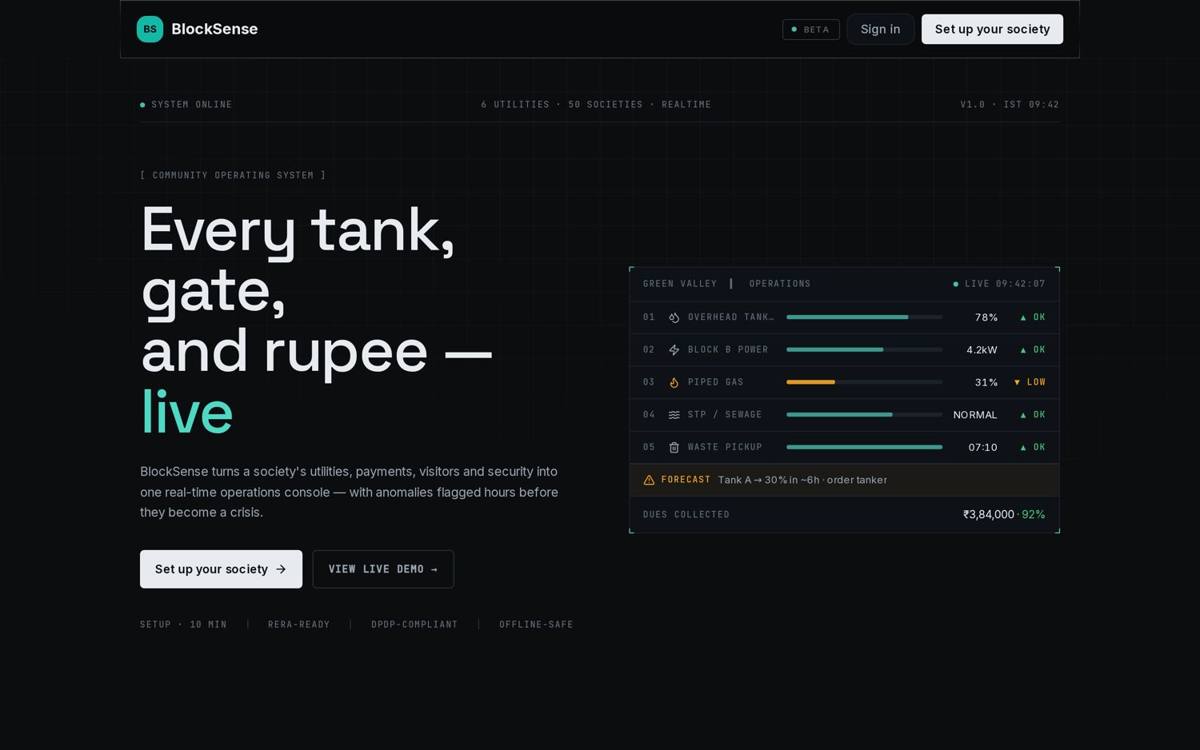
A gated society in India is run by a three-person volunteer committee with a WhatsApp group, a guard with a notebook, and a treasurer with a spreadsheet. BlockSense is the studio's own product for that job: one system where the committee, the residents and the gate each see exactly what they need, and the water tank warns you before it runs dry rather than after.
Why the WhatsApp group fails
WhatsApp was built for chatting with friends. Societies use it to run water supply, security, dues and complaints, which means the tank reading from Tuesday is 400 messages up, the visitor the guard let in is in nobody's record, and the treasurer reconciles maintenance by hand every month. Most software sold to Indian RWAs is adapted from tools built for other markets, with no idea what a maintenance charge structure looks like or how a 200-flat society is actually staffed.
Three portals, one source of truth
- The committee console. Water, power and sewage levels, live. Dues and collections. Complaints with an owner and a state. Monthly reports bounded to the month, so they load in a second rather than scanning every record the society ever had.
- The resident app. An installable PWA: pay dues, raise a complaint, pre-approve a visitor, see the notice board. Residents only ever see their own flat's data, enforced on the server, not in the interface.
- The gate. A guard-facing screen that accepts a visitor's pass code and shows who approved it. No notebook, no phone calls upstairs.
The part that matters: prediction, not reporting
A dashboard that shows a tank at 18% is a report. BlockSense works out the rate of consumption and messages the committee on WhatsApp when a tank is on course to be empty, while there is still time to order a tanker. The same goes for the diesel in the DG set. A reading that arrives after the problem is just a record of the problem.
Real-time, and what that costs
Every reading, payment and gate event reflects across all three portals within roughly 100 milliseconds. The database is Convex, which pushes changes over a persistent connection rather than having each screen poll. The cost of that choice is discipline about what runs on every update, which is why the reports are bounded and the queries are indexed rather than clever.
Built for India, which is a specific thing
- DPDP Act 2023 consent is recorded per resident, not assumed. Deletion requests cascade through every table that ever touched the record. Data ages out on a retention schedule.
- RERA-aware structures for maintenance charges and common-area accounting.
- Payments are idempotent. A resident who taps pay twice on a bad connection is charged once.
- Accessible by default. Keyboard-operable everywhere, honours reduced-motion, contrast checked against WCAG.
Stack
Next.js 14 on the App Router, Convex for the database and serverless functions, WhatsApp Cloud API for alerts and the weekly digest, Sentry for errors, and a shared design-token system so the web console and the resident app cannot drift apart visually. Deployed on Vercel.
Running something on a group chat and a spreadsheet?
Societies, clinics, workshops, franchises. The operations platform starts at ₹5,50,000 and the audit that scopes it starts at ₹60,000.