Your bank SMS, turned into a ledger that argues back
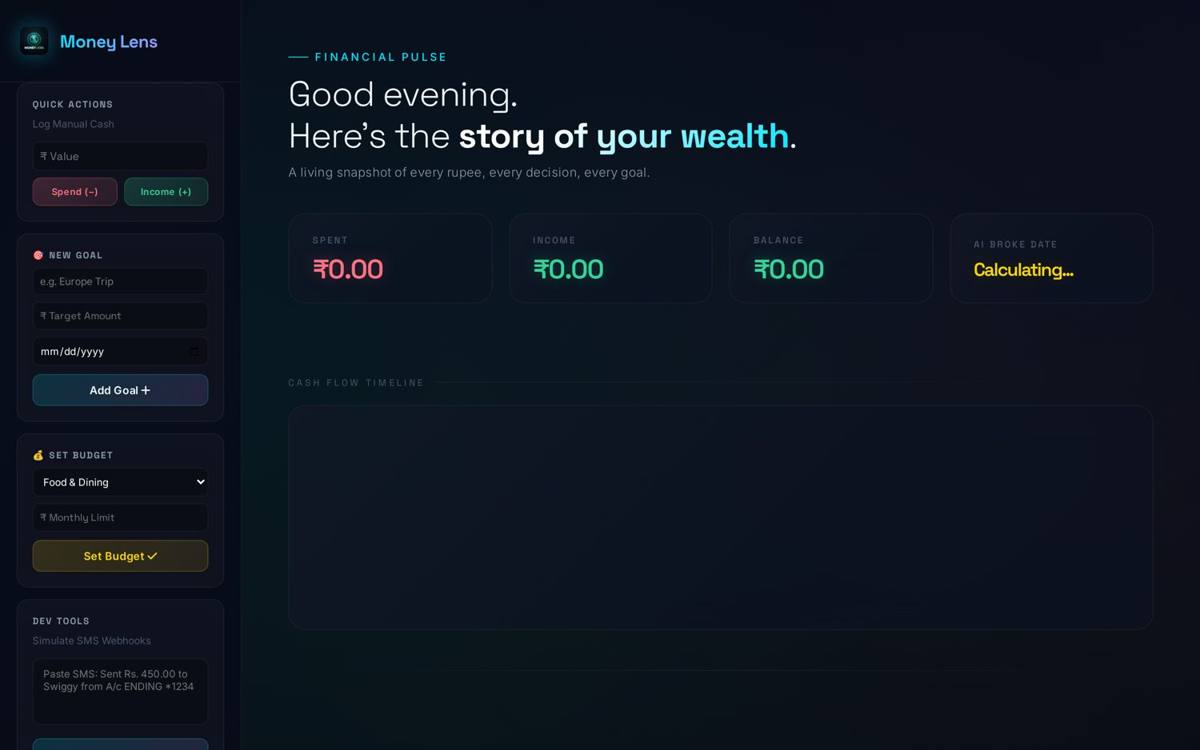
Every Indian bank already sends you a text for every transaction. Money Lens reads them. It sorts each payment into a category on its own, finds the subscriptions you forgot you had, tells you the date your balance hits zero at your current rate, and takes instructions in plain English. It is open source, and it is the proof behind the studio's document-extraction and AI-agent work.
The input is a mess, on purpose
A bank SMS is not designed to be read by software. Each bank formats it differently, the same bank changes its format without notice, UPI messages look nothing like card messages, and the merchant name is whatever the payment gateway felt like sending. The parser handles the formats from HDFC, ICICI, SBI, Axis and others, and the categoriser assigns each transaction without asking you to tag anything.
This is the same problem as reading an invoice, a delivery note or a doctor's letter: messy, real-world text that a person can read in a second and software usually cannot. It is the foundation of everything the studio does under AI that does the actual work.
What it tells you that your bank app does not
- The broke date. Given your balance and your burn rate, the day you run out. Not a chart to interpret, a date.
- The subscriptions radar. Recurring payments are detected automatically and added up into a single fixed monthly burn. Most people find at least one they had forgotten.
- A 30-day cash flow line that shows where the balance is heading, not just where it has been.
- Multi-wallet. GPay, PhonePe, cards, cash and bank transfers reconcile into one ledger.
- Budgets that shout. Set a limit per category; breach it and the app assigns a recovery mission instead of a red number.
The agent that acts
The chat is not a help bot. Say save 500 for the Europe trip and it creates the goal and moves the money. Ask what you spent on food last week and it answers from the ledger. It is a tool-using LLM loop with structured extraction over the real data, and it is the pattern behind the studio's agents that use your tools work: the model decides, the code executes, and every action is logged.
Stack
Python and FastAPI on the server. A regex-and-rules engine for parsing, with an LLM only where rules run out. Chart.js for the timeline. SQLite locally and Supabase in production. Deployed on Vercel. The whole thing is on GitHub, including the blueprint document, so you can read exactly how it is put together.
Paperwork arriving faster than you read it?
Invoices, delivery notes, bank statements, forms. AI agents and document automation start at ₹2,25,000, two to four weeks.