A course platform that opens one student at a time
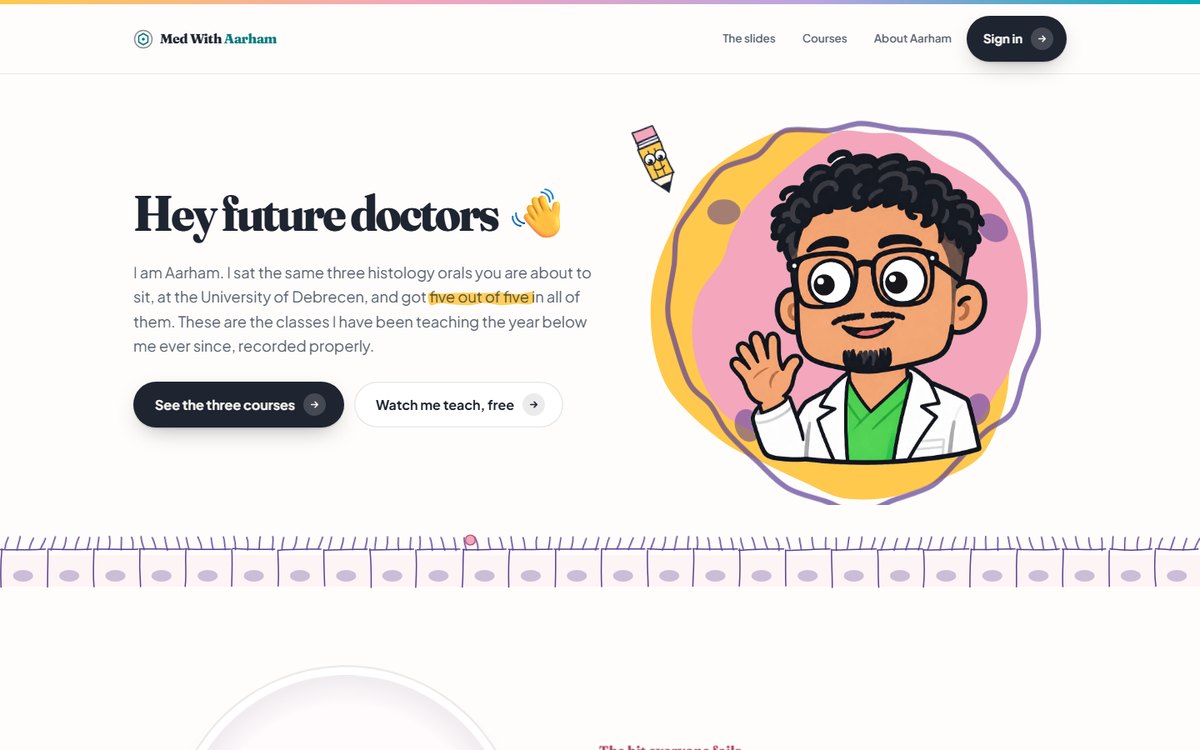
Muhammed Aarham is a dental student at the University of Debrecen in Hungary. He sat three histology orals and scored five out of five in all of them, then spent three years teaching the year below him, live, one room at a time. The classes were good and only the people in the room ever heard them. This is that teaching, recorded, on his own domain, with a door that opens for one student at a time.
Why not a course marketplace
A marketplace takes a cut, owns the student relationship, decides how the page looks, and can change its terms next semester. Aarham wanted the opposite: his name on the door, his prices, his record of exactly who has access, and no monthly fee to anyone. That is a platform, not a listing, and it is the kind of thing people assume needs a company to build.
What a student sees
- Try before you pay. Two minutes and fifty seconds of Aarham teaching, free, no sign-up, so you can hear how he explains things before spending anything.
- Three courses, paid once. Basics of Histology, Neurohistology and Non-Organ Histology, and Organ Histology, 22 topics between them, in the order the examiner asks for them. Nothing renews and nothing expires halfway through the semester.
- A checkout that hands you a code. Pay by bank transfer, put the short code in the reference, and Aarham matches the payment by hand. Your account is switched on, usually within hours and always within one working day. You get an email, you sign in, everything is there.
- Thirteen students, in their own words. Messages sent after exams, published with permission, names removed, nothing else changed.
What Aarham sees
Every course request, paid or unpaid. A daily sweep reminds anyone who requested and did not pay. One click grants access. The list of who has what lives in his database, on his account, and would survive the studio disappearing tomorrow.
The parts that had to be right
- Video that cannot be shared by link. Lessons stream from Bunny Stream through signed URLs, so a student's browser never learns an address that works for anyone else. Fullscreen works on the video itself, not the page around it.
- Email that lands. Sent from hello@ on his domain with a real Reply-To, so a student who replies reaches him and does not bounce.
- The boring security. Login rate limiting, a strict content security policy, public pages cached at the edge, secrets held as Cloudflare secrets rather than config.
- Devices, not seats. Students manage their own signed-in devices. No per-seat pricing anywhere in the system.
Stack, and why it was fast
React Router v8 with TypeScript, running on Cloudflare Workers so there is no server to rent or patch. Neon for Postgres. Bunny Stream for video. The stack was chosen for two reasons: it costs almost nothing to run at a few hundred students, and it let the first commit become a live domain in under three weeks.
Where it is now
The platform is live and taking checkouts. The three courses are being recorded as this is written, which is the one part of the project the software cannot speed up.
Have something to teach, or sell, on your own domain?
A storefront starts at ₹35,000. A platform with logins, payments and access control is scoped on a twenty-minute call and priced before anything is built.